AI-first or business-first?
Hi!
I recently started as Head of AI at Cloudamite and thought I’d start writing here on our blog about business and tech working as one team. That is something we see as the foundation for any company that wishes to excel in digitalisation. Get that right, and the rest is much easier.
How AI is transforming product development
Software engineering is changing rapidly from a coding-heavy to an intent-heavy discipline. The new workflow is referred to as spec-driven development as development happens through natural language specifications and AI handles the actual coding. This is wonderful as teams can now focus on the actual problem solving. The new workflow naturally leads to writing (and reviewing!) intent before code and therefore gives software development the rigor it demands — thinking thoroughly about the business requirements rather than jumping to busy work of coding too early.
Converging on the intent really helps. It avoids spending time in “rabbit holes” one shouldn’t have entered in the first place. This is what people are referring to when they report about productivity gains using agentic tools. And it is not only about doing things faster than before, but also about achieving things that would not have been possible earlier.
This is quite funny actually – it is the use of AI which is nudging us towards defining our product requirements in natural language; a task that used to be seen as tedious and unnecessary complication is now becoming the natural means to spark alignment discussions between business, product, and tech.
Mapping AI workflows
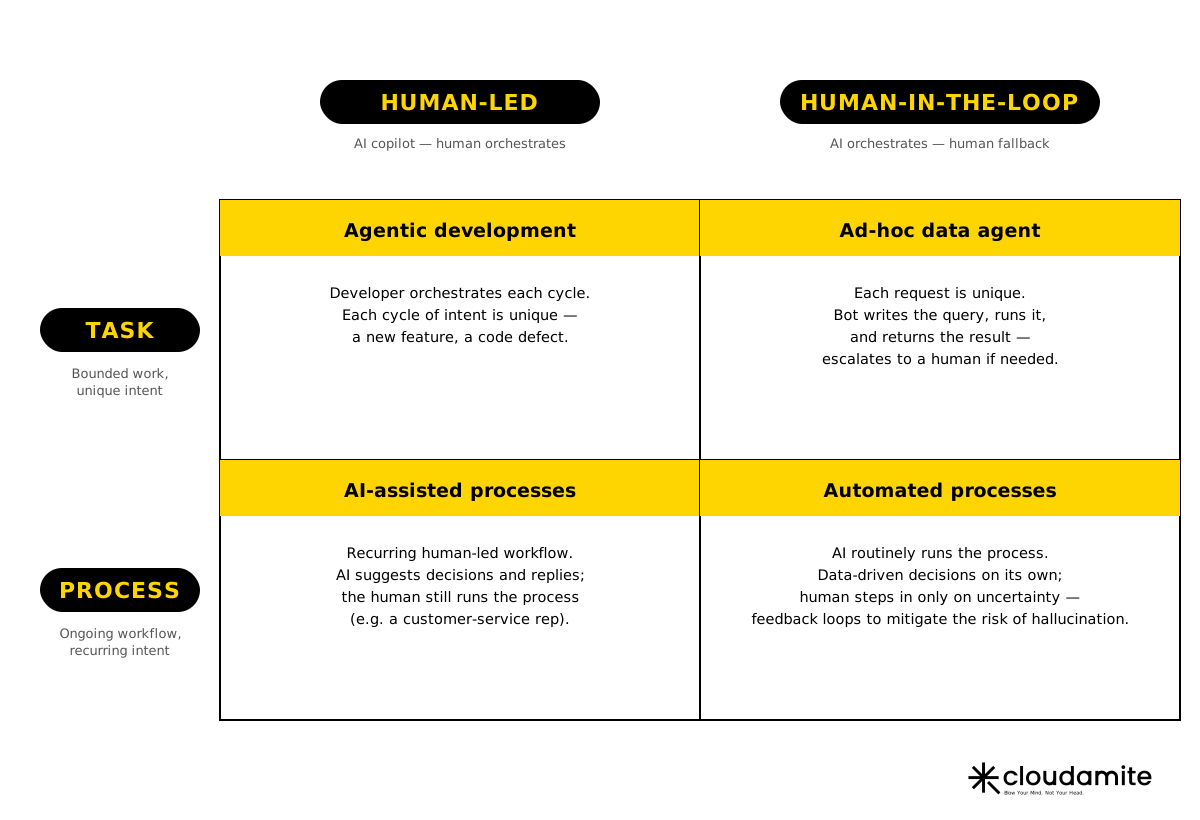
It is useful to map AI workflows on two axes:
“task vs. process”:
- Task: a unit of ad-hoc work.
- Process: a standardised business process the AI is embedded in.
“human-led vs. human-in-the-loop”:
- Human-led: a person is driving the task or process cycle through, assisted by AI for some part.
- Human-in-the-loop: task or process cycle is automated, yet sometimes AI may prompt a decision from a human.
This helps classify different ideas and align expectations when discussing them with others.
Human-led, task
Agentic software development today lands in the “human-led, task” quadrant, as it is mostly orchestrated by the developer and each cycle of intent is unique: developing a new feature or fixing a specific code defect. Another example of this category is creating a digital marketing campaign where a human brainstorms ideas with an AI and creates a marketing plan.
Human-led, process
This category is still very much orchestrated by a human but now the intent is less unique. One example could be AI-assisted reclamation handling where customer complaints are handled by customer service. AI can help collect required information from the customer automatically and an AI could suggest a decision and write a custom response. However, the process still depends on a human to complete each cycle.
Human-in-the-loop, task
Each task is unique, but the AI runs the cycle — the human only steps in when AI flags uncertainty. This category covers activities we previously thought weren’t worth automating: writing a one-off script wasn’t worth the effort, but now that AI can write the script it can also run it. It works when the probability of success is high and the cost of a miss is low. One example is an agent handling ad-hoc data requests: a director asks “pull all orders from last week where shipping was delayed more than 48 hours” and the agent writes the query and returns the result (or involves a data engineer to help). Always build the human-in-the-loop fallback as insurance; it is hard to bolt on later.
Human-in-the-loop, process
Final category is where AI is routinely running a business process, day in and day out. It knows what the business goals are and makes data-driven decisions mostly on its own reasoning. Option to involve human is still there and most sophisticated solutions should have feedback loops to adjust the threshold when that path is taken. This is by far the most challenging to implement, but this is also where the biggest gains are.
Start with why – not the tech
Most buzz about AI has been about the human-led, task category which is familiar to the general public through free web chats. Extension of that has been AI harnesses such as Claude Code, where investments are truly paying off. Companies that have explored human-in-the-loop categories are mostly reporting underwhelming returns on investment. In some cases that is because human-in-the-loop is not working properly or it is not even built in.
The bigger issue, why AI investments have not delivered, might however be the mindset where development has been tech-first and changes to process have been point solutions rather than holistic re-design.
We believe better results are reached through systematic problem solving:
- Define the “Why” & metrics: We start with clear business goals and the high-level metrics to measure them.
- Identify opportunities: We find where data and AI can aid in bridging gaps and be the magic ingredient for a more efficient process.
- Roadmap alignment: We tie your technology roadmap directly to the identified business opportunities, which creates clarity and keeps focus.
We are still in early phases of AI transformation and progress is extremely rapid. It is however not too early to run continuous value discovery in order to identify where data and AI can help your business. In many cases impact can be delivered merely by surfacing the data to the right person at the right time. If AI is truly what will deliver you an unfair advantage over your competitors, then it is better to build AI around your process rather than vice versa.
Let’s talk.
We’d be curious to know what type of workflows you are currently working on or what you’d like to achieve.
Let’s connect on LinkedIn or email.
Feel free to share this post on LinkedIn if you found this insightful.